

The Hidden Multiplier: How Clearing Your Record Today Maximizes Your RIA’s Exit Value

FINRA Panel Clears Baseless Advisory Fee Dispute For Florida Financial Advisor

RIA Partnership Disputes: The Critical Risk of CRD/IARD Super Account Administrator (SAA) Control

FINRA Panel Grants Triple Expungement For New York Financial Advisor
CE Credit Course: Outsourced CCO (OCCO) Services for RIAs
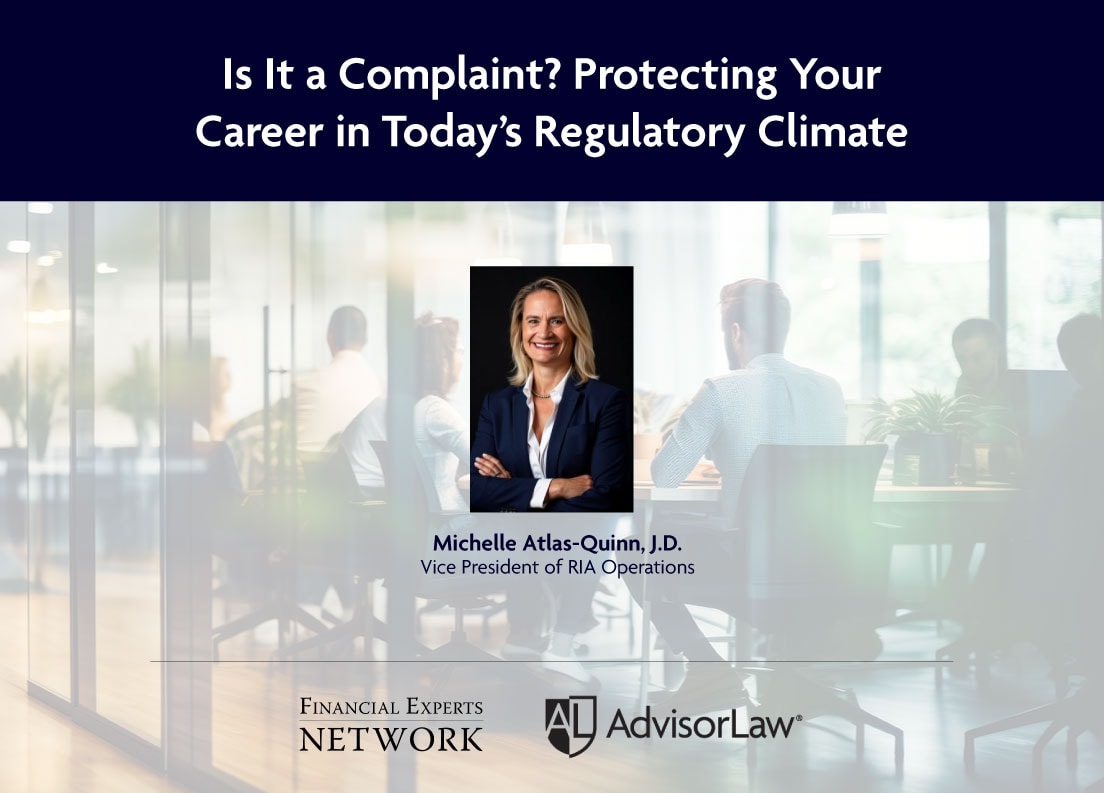
The line between an "unhappy client" and a "reportable event" has become razor-thin. Last year, Michelle Atlas-Quinn, J.D., from AdvisorLaw led a high-impact webinar with the Financial Experts Network that remains the gold standard for navigating this minefield: "When It Might Be a Complaint: What Every Investment Adviser Rep (IAR) Needs to Know."
With an 89% excellence rating, this session highlighted a critical reality: how you handle a single phone call or email today can determine your ability to practice tomorrow.
1. The 2026 Definition of a "Complaint"
In 2026, regulators aren't just looking for formal letters of intent to sue. Any negative communication—verbal or written—can be deemed a complaint depending on your firm's compliance manual.
- The "Immediate" Rule: Terms like "timely" now frequently mean 1–3 days. Waiting to see if a client "cools off" before notifying compliance is a recipe for a failure-to-supervise charge.
- Metadata Matters: Never alter a CRM record after a complaint is voiced. Forensic compliance tools used by the SEC and FINRA in 2026 can detect changes in metadata instantly, turning a minor complaint into a "willful falsification" charge.
2. Form U4 Question 14I: The Reporting Triggers
The rule permits any employee of the firm, even covered associates, to contribute up to $350, in aggregate, per election cycle, to eachMichelle Atlas-Quinn provided a deep dive into the triggers for Item 14I on Form U4. Even in 2026, these thresholds remain the critical benchmarks for your public record: candidate for whom the employee is entitled to vote, and $150, in aggregate, per election cycle, for each candidate for whom the employee is not entitled to vote.
- Sales Practice Violations: Any written or verbal complaint alleging a sales practice violation (like churning or unsuitability) involving $5,000 or more must be reported.
- Settlement Thresholds: Any matter settled for $15,000 or more triggers an automatic disclosure.
- The "Serious" Allegations: Allegations of theft, forgery, or misappropriation are automatically investigated by regulators, regardless of the dollar amount.
3. The "Ticking Clock" on Expungement
If a complaint is false or erroneous, you must act quickly. As of January 2026, the window for "straight-in" expungement requests has tightened significantly.
- The 2-Year Rule: You have exactly two years from the close of a customer arbitration or civil litigation to file for expungement.
- The 3-Year Rule: For written complaints that didn't go to arbitration, you have three years from the date it was first reported to the CRD.
- The "Closed" Window: Many transition periods for older claims have officially ended. If you miss these deadlines, that disclosure becomes a permanent scar on your BrokerCheck record.
4. Professional Obligations: Beyond FINRA
Your reporting duties don't end with your firm.
- CFP Board Requirements: The CFP Board requires written notice within 30 calendar days of both the initiation and the conclusion of a reportable matter. Failure to self-report can result in the revocation of your marks, even if the underlying complaint is eventually denied.
- E&O Insurance: Most Errors & Omissions policies require "timely notice" of potential claims. Delaying a report to your carrier can result in a denial of coverage, leaving you to pay for your defense out of pocket.
5. Best Practices for Risk Prevention
- Neutral Language: When responding to a U4 disclosure, avoid emotional or defensive language. Use standard phrasing such as: "Representative denies all allegations related to this matter."
- Proactive Communication: Most 2026 complaints stem from poor communication during market volatility. Staying in touch is your best defense.
- Staff Training: In 2026, you are more liable than ever for the mistakes of your staff. Ensure your entire team knows how to spot a "complaint" in a casual conversation.
How AdvisorLaw Can Help
The process of expunging a meritless complaint is more rigorous than ever, often requiring a three-person specialized arbitration panel and court confirmation. AdvisorLaw specializes in protecting advisor reputations by:
- Identifying Reportable Events: Helping you determine what actually needs to be disclosed.
- Expungement Advocacy: Navigating the complex FINRA and court systems to clear your record.
- CFP Board Defense: Managing the unique ethics and reporting requirements of the CFP Board.
Contact us today for a free consultation and learn how AdvisorLaw can help safeguard your practice.
Watch the full video for CE Credit here:
Engage with our experts today!